How to Pray the Holy Rosary: A Catholic Guide to Prayer and Meditation
The Holy Rosary invites us to pause, turn our hearts toward God, and reflect on the saving work of Jesus Christ in the company of His Blessed Mother. Whether we come with gratitude, sorrow, uncertainty, or hope, this prayer gives us a way to place our lives before the Lord.
The heart of the Rosary is meditation on Jesus Christ. As we pray its familiar prayers, we contemplate His birth, ministry, suffering, Resurrection, and glory. Saint John Paul II explains this Christ-centered character in his apostolic letter Rosarium Virginis Mariae. vatican.va
1. What Is the Holy Rosary?
The Rosary combines spoken prayers with meditation on the mysteries of salvation. Here, “mysteries” means the saving events we contemplate in faith.
A usual five-decade Rosary includes five mysteries. Each decade consists of an Our Father, ten Hail Marys, and a Glory Be, prayed while reflecting on one mystery. Four sets—Joyful, Luminous, Sorrowful, and Glorious—provide twenty mysteries altogether. USCCB
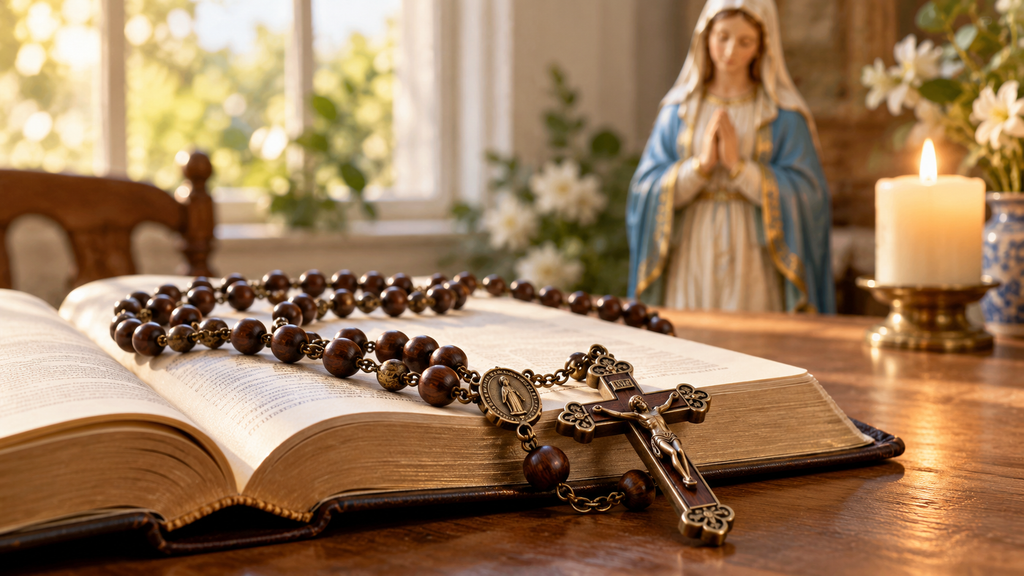
The beads help us keep our place so that we can give more attention to prayer. Their purpose is to support contemplation. Saint John Paul II also draws attention to the crucifix: the Rosary begins and leads us back to Christ. vatican.va
2. Why Do Catholics Pray With Mary?
Catholics honor Mary as the Mother of Jesus and ask for her intercession—her prayers on our behalf.
Worship belongs to God alone: Father, Son, and Holy Spirit. The Church distinguishes the honor given to Mary from the adoration given to God. Her maternal care depends entirely on Christ and His saving work; it does not diminish His unique role as our Mediator.
Praying the Rosary expresses this relationship: we honor what God has accomplished in Mary and ask her to help us draw closer to her Son. This teaching is explained in the Catechism of the Catholic Church, paragraphs 969–971. vatican.va
3. Preparing to Pray
Before beginning, take a moment to settle yourself. You might find it helpful to:
- Choose somewhere you can pray attentively.
- Have the mysteries and prayer texts nearby.
- Decide which set of mysteries you will contemplate.
- Bring a particular person, need, or thanksgiving before God.
Your intention might concern your family, someone who is sick, peace in the world, or the grace to forgive. You may also pray simply to praise God. The Catechism teaches that intercession, thanksgiving, petition, and praise all belong to Christian prayer. IntraText
There is no need to compose an elaborate introduction. Begin with the concerns already on your heart.
4. How to Pray the Rosary, Step by Step
The following is a widely used sequence:
- Make the Sign of the Cross.
- On the crucifix, pray the Apostles’ Creed.
- On the first large bead, pray the Our Father.
- On the next three small beads, pray three Hail Marys, one per bead.
- Pray the Glory Be.
- Announce the first mystery. Pause briefly, then pray the Our Father.
- Pray ten Hail Marys, contemplating that mystery.
- Pray the Glory Be. You may add the Fatima Prayer.
- Repeat for the remaining four mysteries, praying one decade for each.
- After the fifth decade, pray the Hail, Holy Queen, followed by the customary concluding versicle and Rosary prayer.
- Finish with the Sign of the Cross.
The Fatima Prayer is a customary addition after each decade, rather than an essential part of its structure. USCCB
For the established prayer texts, use the USCCB’s Rosary guide and the Vatican’s Rosary prayers.
5. Which Mysteries Should You Pray Each Day?
The commonly followed weekly arrangement is:
| Day | Mysteries |
|---|---|
| Monday | Joyful |
| Tuesday | Sorrowful |
| Wednesday | Glorious |
| Thursday | Luminous |
| Friday | Sorrowful |
| Saturday | Joyful |
| Sunday | Glorious |
This arrangement is a guide for devotion, not a binding rule. Saint John Paul II explicitly allows adaptations for spiritual needs and particular liturgical celebrations. vatican.va
6. The Joyful Mysteries
The Joyful Mysteries invite us to contemplate the coming of the Savior and His childhood.
- The Annunciation — Luke 1:26–38
Gabriel announces that Mary will bear Jesus. We contemplate her faithful acceptance of God’s call. - The Visitation — Luke 1:39–56
Mary visits Elizabeth. Their meeting invites reflection on faith, joyful praise, and loving service. - The Nativity — Luke 2:1–20
Jesus is born in Bethlehem. We contemplate the humility of the Son of God entering our human life. - The Presentation in the Temple — Luke 2:22–38
Mary and Joseph bring Jesus to the Temple. We reflect on their obedience and the recognition of Jesus as the promised Savior. - The Finding of Jesus in the Temple — Luke 2:41–52
Mary and Joseph find Jesus among the teachers. We contemplate His relationship with the Father and Mary’s pondering heart. The Mysteries of the Rosary
A question for personal reflection: Where is God inviting me to respond with greater trust?
7. The Luminous Mysteries
The Luminous Mysteries focus on Christ’s public ministry.
- The Baptism of Jesus in the Jordan — Matthew 3:13–17
The Father identifies Jesus as His beloved Son, and the Holy Spirit descends upon Him. - The Wedding at Cana — John 2:1–11
Jesus performs His first sign. Mary directs the servants to follow His instructions. - The Proclamation of the Kingdom and the Call to Conversion — Mark 1:14–15
Jesus announces God’s Kingdom and calls people to repentance and faith. - The Transfiguration — Matthew 17:1–8
Christ reveals His glory to Peter, James, and John. The Father calls them to listen to His Son. - The Institution of the Eucharist — Matthew 26:26–29
At the Last Supper, Jesus gives His disciples His Body and Blood. We contemplate His self-giving love. The Mysteries of the Rosary
A question for personal reflection: What would it mean to listen more faithfully to Jesus today?
8. The Sorrowful Mysteries
The Sorrowful Mysteries lead us through Christ’s Passion and death.
- The Agony in the Garden — Matthew 26:36–46
Jesus prays in profound anguish and submits Himself to the Father’s will. - The Scourging at the Pillar — Matthew 27:26
Jesus endures the violence of scourging before His Crucifixion. - The Crowning with Thorns — Matthew 27:27–31
Soldiers mock Jesus and crown Him with thorns. We contemplate the suffering King. - The Carrying of the Cross — Mark 15:21–22
Jesus is led to Golgotha, and Simon of Cyrene is compelled to carry His cross. - The Crucifixion and Death of Jesus — Luke 23:33–46
Jesus dies on the Cross, praying for forgiveness and entrusting Himself to the Father. The Mysteries of the Rosary
A question for personal reflection: What suffering, sorrow, or need for forgiveness can I bring before Christ?
9. The Glorious Mysteries
The Glorious Mysteries direct our hope toward Christ’s victory and the life to come.
- The Resurrection — Luke 24:1–12
Jesus rises from the dead. - The Ascension — Mark 16:19
The risen Lord ascends into heaven. - The Descent of the Holy Spirit — Acts 2:1–4
The Holy Spirit comes upon the disciples at Pentecost. - The Assumption of the Blessed Virgin Mary
We contemplate Mary being taken, body and soul, into heavenly glory. - The Coronation of Mary as Queen of Heaven and Earth
We contemplate her heavenly queenship in union with her Son. The Mysteries of the Rosary
The Assumption and Coronation are not narrated in Scripture in the same way as the Resurrection or Pentecost. The Church teaches Mary’s Assumption and heavenly queenship in the Catechism, paragraph 966. Biblical passages used alongside these mysteries serve as readings for contemplation, rather than direct historical accounts of those events. vatican.va
A question for personal reflection: How can Christian hope shape the way I face today’s difficulties?
10. Understanding the Hail Mary
The Hail Mary has deep biblical roots. Its opening recalls Gabriel’s greeting at the Annunciation and Elizabeth’s greeting at the Visitation. The prayer then asks Mary to intercede for us throughout life and at death.
Calling Mary “Mother of God” expresses faith in the identity of her Son: Jesus is truly God incarnate. It does not mean Mary existed before God or brought the divine nature into existence.
The Catechism explains the Hail Mary in paragraphs 2676–2677, showing how the prayer joins praise for God’s work with trust in Mary’s intercession. vatican.va
11. How to Meditate While Praying
Meditation can begin simply:
- Read the Scripture passage associated with the mystery.
- Notice one action, word, or response.
- Keep that aspect of the mystery in mind during the decade.
- Consider how it calls you to live.
For example, during the Visitation, you might reflect on someone who needs your time or practical help. During the Agony in the Garden, you might bring a difficult decision before God.
These are suggestions for personal reflection, not additional prescribed prayers.
The repeated prayers should support loving attention. Saint John Paul II warns against reducing the Rosary to mechanical recitation: contemplation gives the prayer its depth. vatican.va
12. Beginning a Lasting Prayer Habit
If you are learning, keep a prayer guide beside you. Choose a manageable time and begin patiently. You might start by learning one decade before gradually becoming familiar with all five.
If you lose your place, calmly continue. If an unfamiliar prayer interrupts your concentration, read it slowly. Learning the Rosary is not an examination.
Prayer requires perseverance as well as openness to grace. The Catechism acknowledges that prayer involves effort and belongs to the wider struggle to live faithfully as a Christian. vatican.va
13. The Rosary and the Sacramental Life
The Rosary belongs within a life nourished by the Mass, the sacraments, Scripture, and charity. Catholic devotions extend prayer into daily life and help us respond to God’s grace; they do not replace the Church’s liturgy.
Its fruits should therefore reach beyond the time spent holding the beads: greater love for God, repentance, patience, forgiveness, and care for others. The United States bishops explain this relationship in their teaching on popular devotional practices. USCCB
Come to the Rosary with the life you actually have, its joys, burdens, unanswered questions, and hopes. Make room to listen, pray with patience, and let each mystery invite a faithful response to Jesus.
-
THE HOLY ROSARY
The Joyful Mysteries(recited Monday and Saturday) The AnnunciationThe VisitationThe NativityThe PresentationThe Finding in the Temple…
-
HOW TO PRAY THE HOLY ROSARY
How to Pray the Holy Rosary: A Catholic Guide to Prayer and Meditation The Holy…
-
